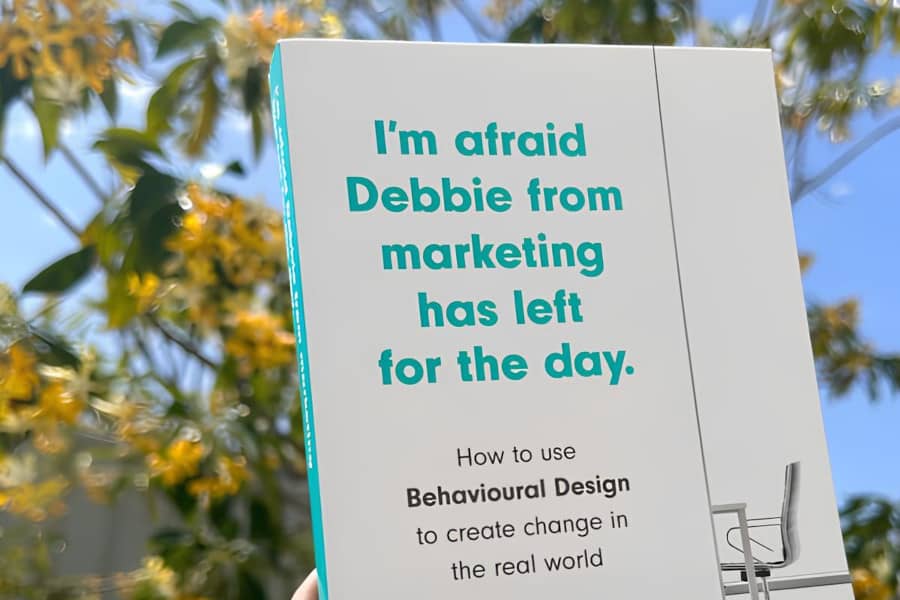
So before my vacation this year this book was recommended to me, the name wasn’t all that revealing so to be honest I wasn’t quite sure what to expect - once you scratch the surface though its genuinely my kind of thing - culture, human behavior, humor and a healthy dose of “lets cut the bullsh#t” - the overall focus is on the way most organizations try (and fail) to change behavior.
The main theme is actually super simple - we massively overestimate the power of information and motivation to change behavior, and massively underestimate how much of what we do runs on autopilot. Most change programs - the town halls, powerpoint presentations, the company value posters, new project communication campaigns etc - are built entirely on the assumption that people are rational, deliberate decision makers who just need the right facts along with the right pep talk. Münster (leaning heavily on Kahneman’s system 1 / system 2 framing) argues that this is just downright backwards. About 90% of what we do runs on system 1 (fast, automatic, habitual) and yet almost all change strategy is designed for system 2 (the slow deliberate thinker who barely gets a look in during a normal workday)
There’s a particular section on the “curse of knowledge” that I found really interesting - the idea that once we know something, we genuinely cannot imagine what it’s like not to know it, so we assume our carefully crafted strategy / presentation is obvious when to everyone else it’s just noise and buzzwords. Anyone who’s sat in a 2 day offsite discussing “we need to be more customer centric” and then tried to explain what that actually means for Dirk back in the office will recognize this instantly. If I’m honest, it also made me reflect on some of my own transformation work - I think I’ve been guilty of this a couple of times.
It’s also refreshingly honest about workplace motivation. Most of us don’t work because of some grand higher purpose - we work because we like our colleagues, enjoy making progress, and appreciate a manageable commute, not because of a mission statement on the office wall. There’s absolutely nothing wrong with admitting that.
One thing I found myself smiling at throughout is how much of this is lean thinking in disguise (even though Münster never once calls it by name) Removing friction from the desired behavior is just eliminating waste. The insistence on concrete, specific guidance over vague strategic mantras is basically the difference between a well-defined standard work instruction and a poster that says “be excellent” and the whole idea of designing your intervention around how work actually gets done in practice (talking to the “users” doing the job rather than the manager who’s “responsible” for it) is basically Gemba walks by another name. It’s a nice reminder that good behavioral design and good process design are really just the same discipline wearing different clothes. Whether we’re trying to get people to wash their hands more or stop a production line to fix a defect, the answer is rarely “explain it better” it’s instead “make the right behavior the easy behavior”
Definitely worth a read if you’re anywhere near culture, transformation, or trying to get people to actually do the thing you keep asking them to do - and it’s a genuinely funny read to boot, which is rare for this kind of book. As always, I’ll leave you with some of my favorite bits I took away…
If more information was the answer, we would all be billionaires with perfect abs.
We cannot imagine what it would be like not to possess the knowledge we now have, and this means that we cannot put ourselves in the place of the listener… all that the audience hear is erratic Morse code.
It’s not the vision statement that gets us out of bed in the morning, it’s the alarm clock.
Thinking is to humans as swimming is to cats; they can do it, but they’d prefer not to.
People choose the path of least resistance… Not because we are lazy, but because this is an effective rule of thumb, especially when we’re trying to conserve the small amount of System 2 energy in our head.
There is a difference between the if-then reward of receiving pretty flowers from your partner on your birthday and receiving a surprising bright bouquet on a dark, rainy Tuesday in November, “just because”.